- +61 7 3374 2877
- Email Us
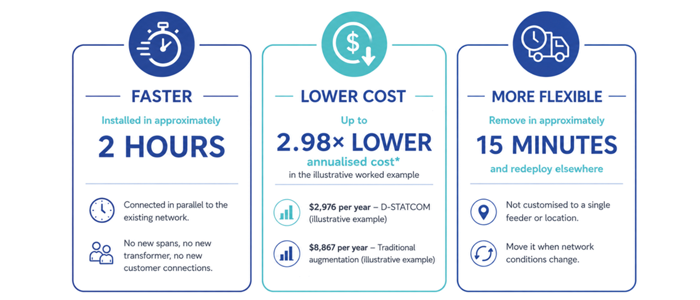
For network planners, the result is a growing number of voltage, phase imbalance and power quality problems that require intervention. The critical question is whether those problems actually mean the network has run out of capacity.
The principle is straightforward: a voltage problem is not necessarily a capacity problem. Where thermal capacity is genuinely exhausted across all three phases, augmentation remains the appropriate response. But where the underlying constraint is overvoltage, phase imbalance, harmonics or certain forms of undervoltage, adding more permanent network infrastructure may not be necessary. That opens the door to a different planning approach.
Start with the constraint, not the solution
Traditional LV augmentation can involve reconductoring lines, installing transformers, extending the medium-voltage network to split feeders and shorten LV runs, or manually transferring single-phase customers between phases. These approaches increase or redistribute network capability, but they can also involve engineering design, construction, outage management, new assets and significant project lead times.
A distribution STATCOM, or D-STATCOM, takes a different approach. Connected in parallel with the existing LV network, it uses power electronics to dynamically address voltage imbalance and harmonic problems. EcoJoule’s EcoVAR, for example, combines three independently controlled inverter-STATCOMs – one for each phase – with a common DC bus. It can exchange reactive current with the network, transfer active power between phases and perform active harmonic filtering.
The distinction is important because a D-STATCOM does not add thermal capacity. Instead, it makes better use of capacity that already exists. That creates a relatively clear first test for planners: identify what is actually binding.