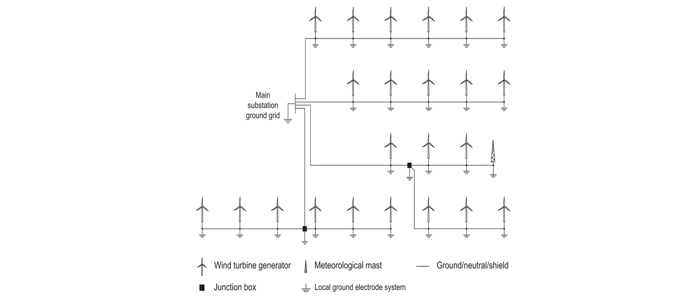
Each wind turbine generator (WTG) is provided with its own local earthing system. In practice, the earthing systems of multiple WTGs are commonly interconnected either through dedicated earth conductors or through the metallic screens of interconnecting cables. Figure 1, reproduced from IEEE 2760, presents a single-line representation of a typical WPP earthing arrangement [1].
APPLICABLE STANDARDS
IEC 61400-24 addresses lightning protection for wind turbine generators and wind power systems. The standard defines the lightning environment applicable to wind turbines and provides a framework for assessing risk under those conditions. It specifies requirements for the protection of blades, structural components, electrical systems, and control systems against both direct and indirect lightning effects. The document also includes test methods for demonstrating compliance and provides guidance on the use of related lightning protection, industrial electrical, electromagnetic compatibility, and earthing standards. Although IEC 61400-24 provides detailed guidance on lightning exposure, component protection, and personnel safety, it relies on other standards for detailed earthing system design [8].
Other important standards relevant to earthing system design include IEC 61936-1, IEC TS 61936-2, IEC 60364-5-54, IEC 60364-6, and applicable national standards. For human safety considerations, IEC TS 60479-1 and IEC TR 60479-4 are also relevant. In the Australian context, AS 2067, Substations and high voltage installations exceeding 1 kV a.c., is the principal national standard applicable to high-voltage earthing design [9].
AS 1768, Lightning protection, is the Australian standard governing lightning protection. Appendix K contains useful guidance on the design of lightning protection and earthing systems for wind turbines. While the standard refers to IEC 61400 for much of the blade protection methodology, it also provides additional guidance on the arrangement of earth electrode systems for a typical WTG [8], [9].
IEEE 2760 is primarily concerned with collector system grounding for onshore wind power plants. Although the guide is not intended specifically for WPP substations, the substation earthing system is typically interconnected with the collector system and therefore both systems can influence one another. With appropriate engineering consideration, the methods described in IEEE 2760 can be used to assess the interaction between collector system grounding and substation earthing performance [1].